

Custom Dashboards
On this page you can see a list of your custom dashboards, create a new one, edit or delete the existing ones.
Compared to the dashboards you will find in the agent views, those custom dashboards are completely customizable: you can add metrics from different agents, from different sources.
Here is an example of a custom dashboard.
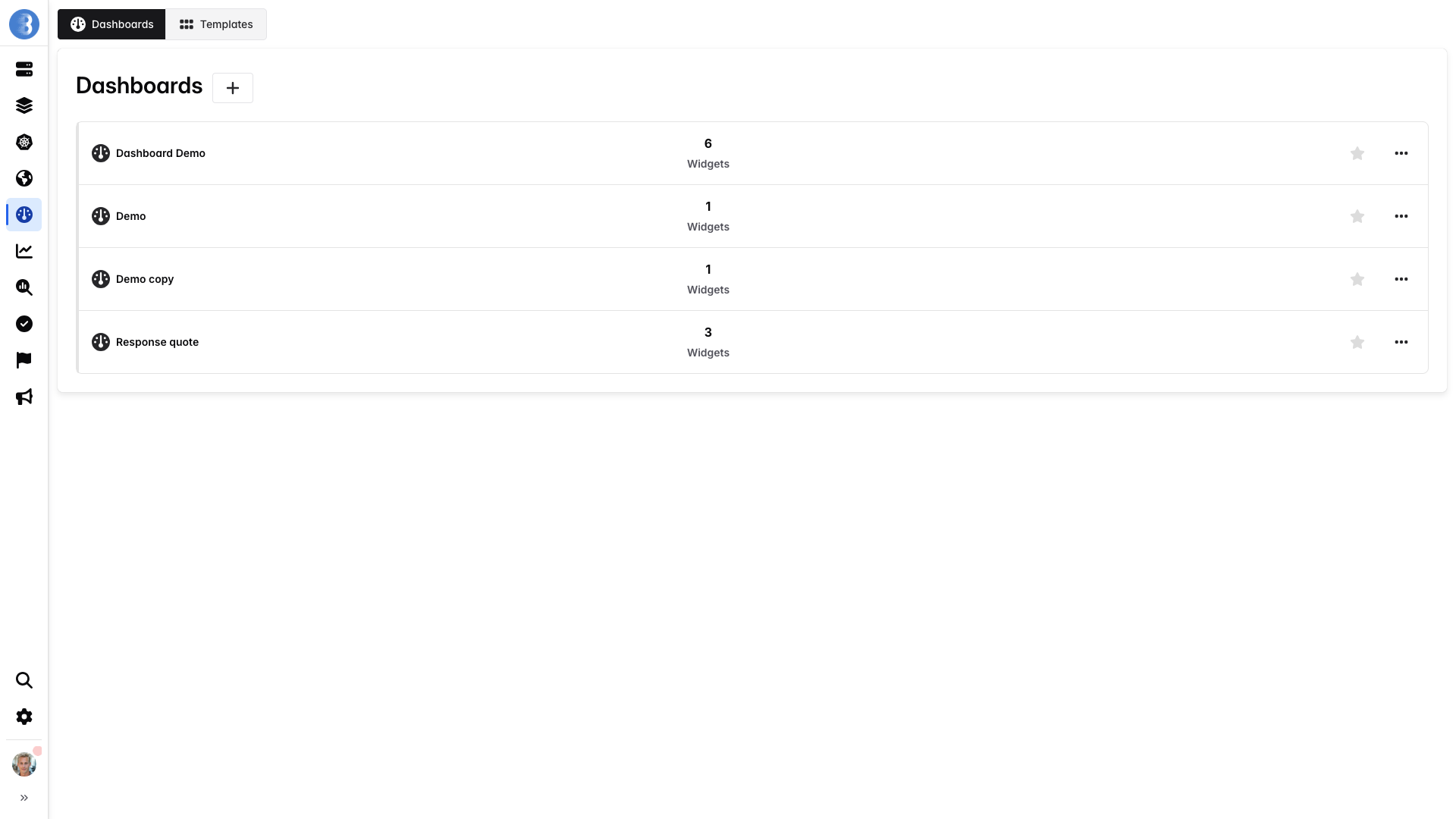
You can click on a dashboard to display it as below.
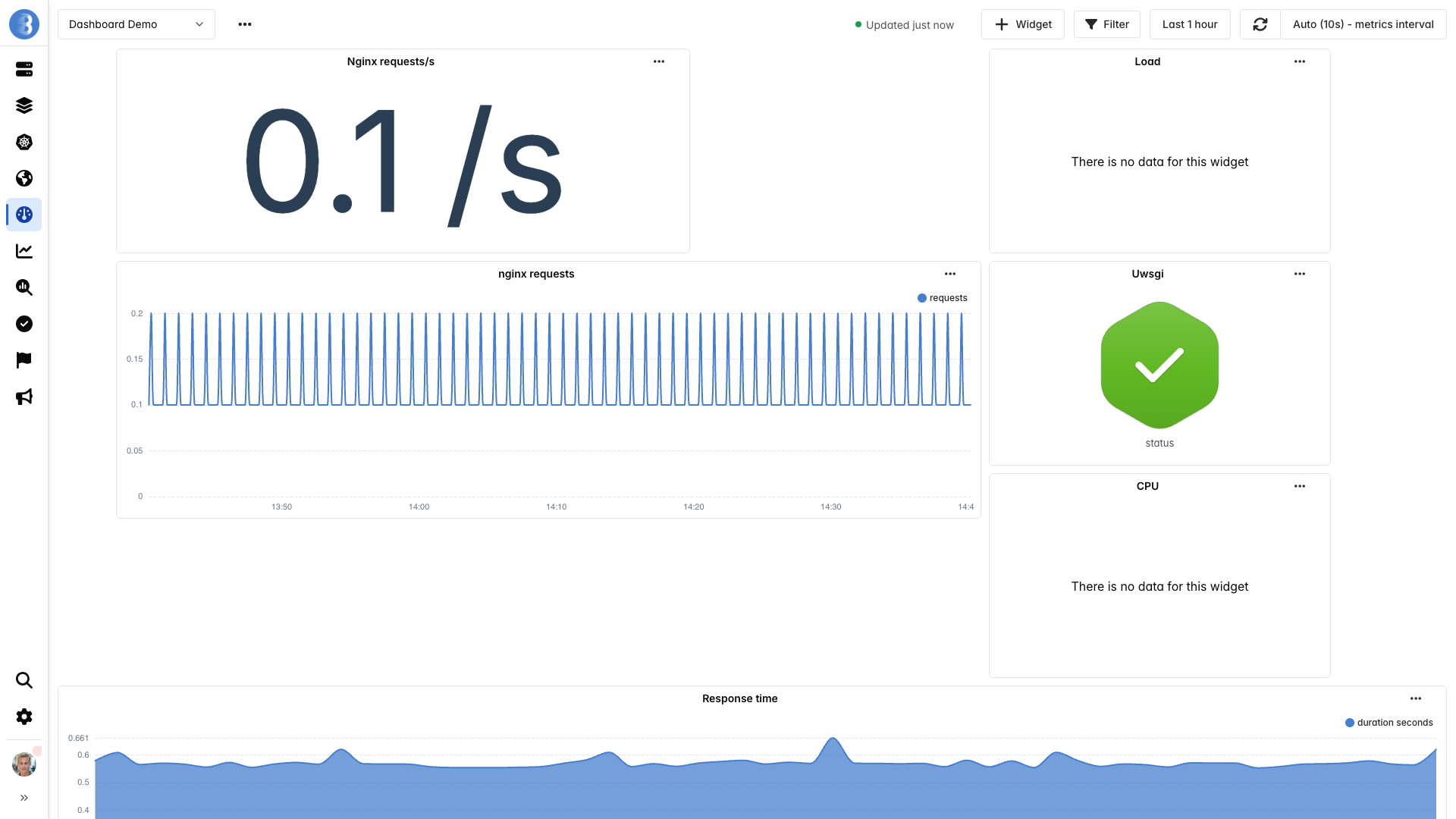
Dashboard Toolbar
Section titled “Dashboard Toolbar”The toolbar at the top of a dashboard holds:
- + Widget, to add a widget to the dashboard.
- Filter, to show every widget for a single label value, see Filter by Label.
- The period selector: Last 1 hour to Last 3 months, Yesterday, or a Custom Period.
- Refresh, to reload the widgets now, and the refresh period selector next to it.
- The actions menu, with Duplicate, Reset (for dashboards created from a template), Export as a JSON (for templates), Show Annotations and Annotations, see Annotations.
The period you pick is shared by every dashboard of the account: switching to another dashboard keeps the same period. It is remembered in your browser, not shared with the other users of the account.
Filter by Label
Section titled “Filter by Label”The Filter button narrows every widget of the dashboard to one value of a metric label, for
example a single item (a disk, a network interface…). Bleemeo lists the labels found on the
metrics shown on the dashboard over the selected period, then the values of the selected label.
The instance label is not offered.
While a filter is active, a chip shows label = value. Click its cross to clear the filter.
The filter is stored in the page URL (filter_label and filter_value), so a link to the
dashboard keeps it. Your browser also remembers the last filter of each dashboard and restores it
when you open the dashboard again. The same filter is available on the
agent dashboards.
If the filtered value no longer exists in the selected period, a warning icon on the chip says so.
Widget Types
Section titled “Widget Types”| Widget | Displays |
|---|---|
| Line Chart | One line per series over the period. Warning and critical thresholds are drawn on the chart. |
| Stacked Area Chart | The series stacked on top of each other. Thresholds are drawn on the chart. |
| Bar | The last value of each series as a bar. |
| Gauge | The last value of a single series against its minimum and maximum. |
| Number | The last value of a single series. |
| Status | The status of one or more status metrics, see Status widget. |
| Heatmap | One cell per series, colored by the range its last value falls in. Heatmaps only display values; use a Status widget for statuses. |
| Text | Free text. |
| Image | An image from a URL. |
| Logs | The latest log lines, optionally of a single agent. |
Status widget
Section titled “Status widget”The Status widget has three sub-types:
- Honeycomb (default): one hexagon per metric, colored by status. A summary next to the widget title counts the metrics per status; click a count to highlight those metrics. Hover a hexagon to see the full name and status of its metric. When a status changes, the hexagon briefly pulses to draw attention to it. Names are written under the hexagons only when they fit on a single row.
- Smiley: a smiley per metric.
- Image: a tile per metric.
A Status widget only accepts status metrics (such as service_status or any metric ending in
_status), and a Heatmap only value metrics. The metric picker of the widget only lists the
matching metrics.
Thresholds on charts
Section titled “Thresholds on charts”When the metrics of a Line Chart or a Stacked Area Chart have thresholds, the chart draws the warning and critical thresholds as dashed lines, colored by severity. The vertical axis is extended when needed so a threshold stays visible even when the values are far below it.
When the series of a chart have different thresholds, the lines show the most common value. Hovering a series moves the lines to the thresholds of that series, and the tooltip lists them. On a stacked chart, thresholds are read against the cumulative value.
Edit Dashboards
Section titled “Edit Dashboards”To edit a custom dashboard, you can use simple mode. Pick the metric of the widget with the metric picker: type part of a metric name to search, the best matches come first, and each entry shows its Prometheus selector.
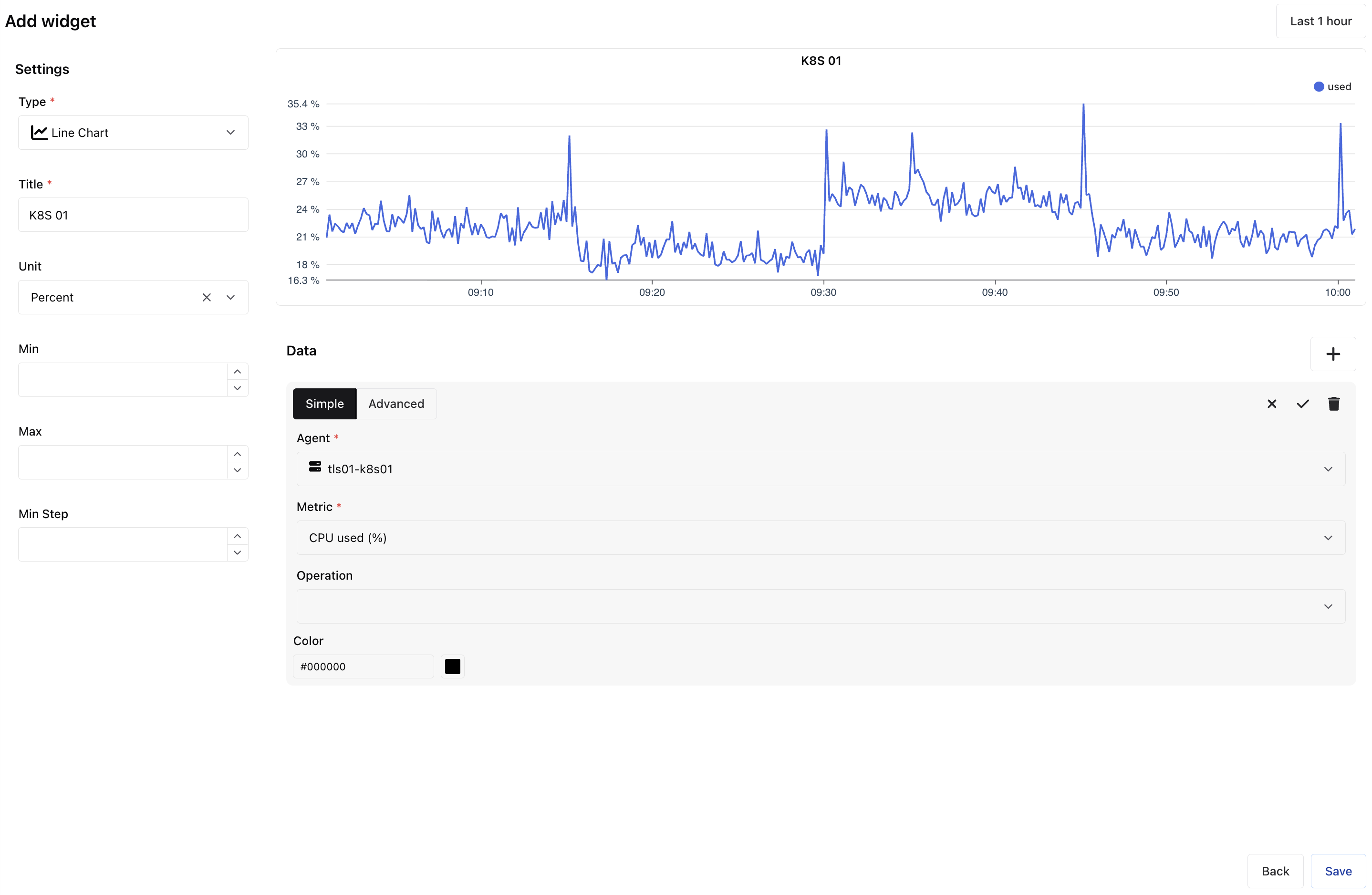
Or advanced mode with PromQL:
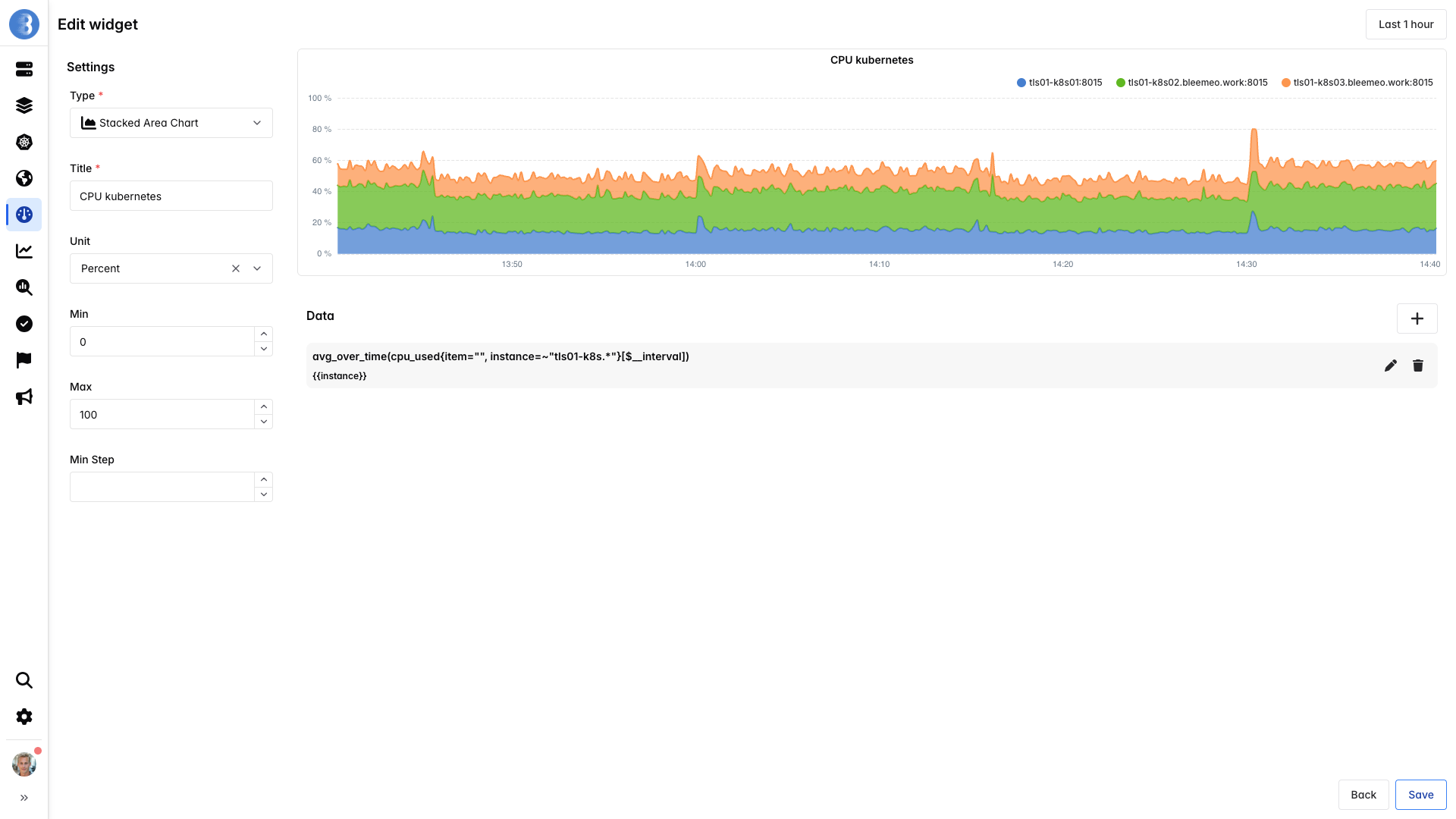
To fine-tune a query before saving the widget, use Open in Metrics explorer next to the PromQL field: it opens the query in the Metrics Explorer in a new tab, so your widget changes are kept.